

 Jun 10
You have invested in a high-speed stick pack machine producing hundreds of single-serve sachets per minute. But those flexible pouches cannot go directly to retail shelves—they need secondary cartoning to protect contents, display branding, and enable efficient logistics. The gap between sachet output and carton input is where many food and supplement producers lose efficiency, create bottlenecks, or damage product.
This guide walks through the specific considerations for integrating stick packs into box packaging. You will learn about infeed compatibility requirements, the trade-offs between different automation levels, and how to plan for the product variety typical in functional foods, nutraceuticals, and coffee sticks. The goal is to help you design a line that matches your volume, reduces manual handling, and maintains product integrity.
Stick packs—narrow, elongated pouches filled with powders, liquids, or granules—present unique challenges when being loaded into cartons.
| Challenge | Why It Matters for Your Line |
|---|---|
| Flexible shape | Pouches do not hold a rigid form; they can bend, bunch, or misalign during transport and insertion |
| Light weight | Low mass makes them susceptible to air currents, static cling, and inconsistent positioning |
| High output from upstream | A single stick pack machine can easily produce 150-300 packs/min; cartoning must match that cadence without jamming |
| Orientation sensitivity | Printed side must face outward; nozzle direction may matter for liquid sticks |
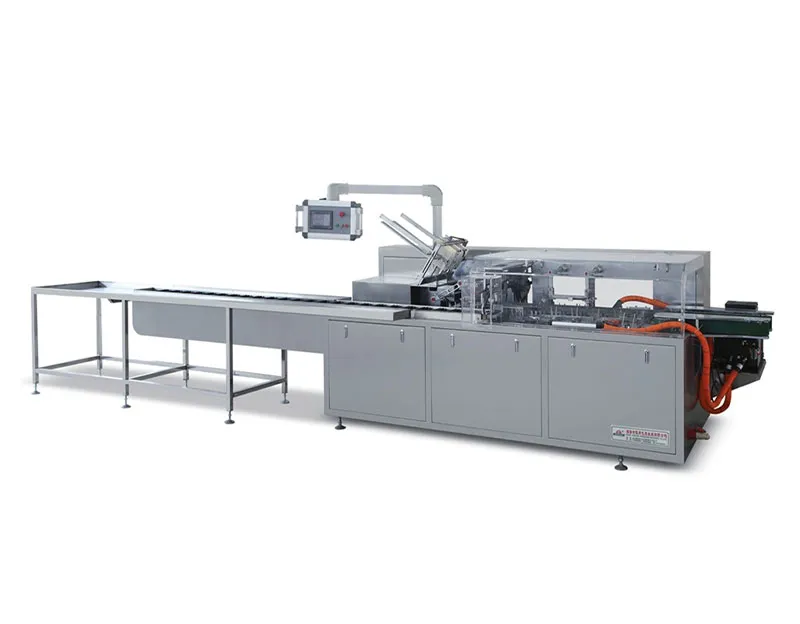
Solving these challenges requires a cartoning system designed specifically for flexible pouch infeed. For stick pack producers running commercial-scale operations, KAIXIANG has developed dedicated integration solutions that can pack 30-60 boxes per minute, accommodating box sizes from (70-250) × (50-120) × (35-105)mm, ideal for coffee, tea, and condiment stick packs.
To see how automated collation and cartoning systems are designed for different speed ranges, you can review the cartoning platforms that integrate with upstream stick pack equipment. View our automatic stick cartoning machine Product Series
Industry classifications typically recognize three primary automation levels for cartoning equipment: automatic, semi-automatic, and manual configurations. The right level for your operation depends on daily output, number of SKUs, and available labor.
How it works: Operators collect stick packs from the sachet machine output, manually count and stack them, then insert them into cartons and close flaps. This approach is suitable for low-volume production scenarios, though it is not the focus of KAIXIANG’s automated solutions.
How it works: Stick packs are automatically counted and collated into groups using a counting conveyor or vibratory bowl. The grouped packs are then manually loaded into a semi-automatic cartoner that erects, tucks, and seals boxes.
Best for: Medium-volume producers transitioning from manual processes to automation, or those with a high product mix requiring frequent changeovers.
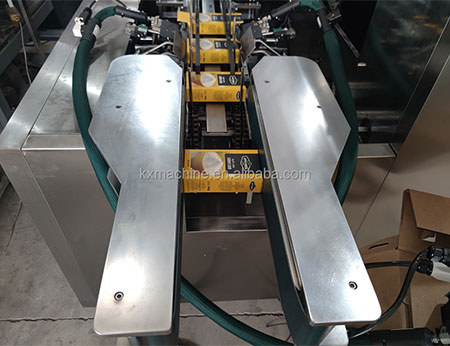
How it works: Integrated system: stick pack machine discharges onto a conveyor that feeds a collation and stacking unit. The stacked group transfers directly into an automatic cartoner. No manual intervention from sachet exit to sealed carton.
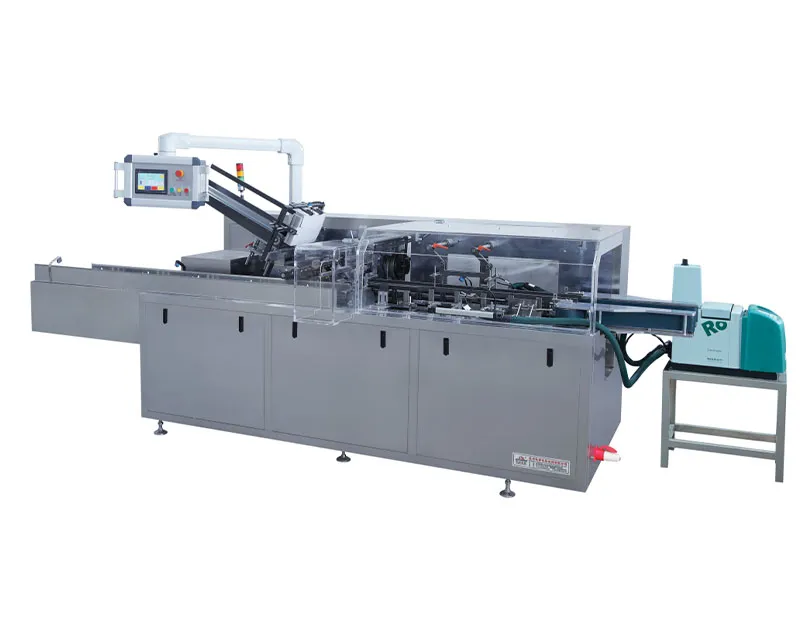
Best for: High-volume producers with dedicated product runs. KAIXIANG‘s KXZ-130B Automatic Stick Food Cartoning Machine operates at 30-60 boxes per minute, designed specifically for coffee, tea, and condiment stick packs.
Before selecting a cartoning solution for your stick packs, evaluate these five aspects with each supplier.
Stick packs vary widely: coffee sticks may be 60mm × 12mm, while supplement sticks can be 100mm × 30mm. Ask the supplier:
What is the acceptable length range for the infeed conveyor?
Can the machine handle sticks that are not perfectly flat (e.g., partially filled powder sticks)?
How does the machine reject misfed or misaligned sticks?
Why this matters: An infeed not matched to your product size will cause frequent jams. Each jam on a high-speed line can cost 5-10 minutes of production.
Two common ways to present stick packs to the cartoner:
| Collation Method | Description | Best For |
|---|---|---|
| Stack collation | Sticks are stacked vertically (5, 10, 20 units), then inserted as a block | Supplement sticks, thicker products that can support stacking |
| Single-file with lay-down | Sticks are laid flat in a single row, multiple rows side by side in the carton | Coffee sticks are lightweight powders that cannot bear weight in a stack |
Ask for a demonstration of your actual product. Stack collation may crush or dent flexible sticks. Single-file lay-down requires precise timing.
Stick pack cartons are typically narrow and tall (e.g., 120mm × 40mm × 30mm). But your portfolio may include:
Single-serve cartons (1 stick) – very small
Multi-packs (10-20 sticks) – longer and wider
Nothing damages a brand's reputation more than a carton missing one stick. The system must:
Detect missing sticks in the collation (via weight check or optical sensor)
Reject the incomplete carton before sealing
Log the rejection for quality records
Ask the supplier: “Show me how your machine handles a missing stick in the middle of a 20-pack collation.” The answer should be automatic rejection of that specific carton, not a line stop.
After loading, cartons need to be closed (tuck or glued) and date/lot coding. Confirm:
Can the cartoner apply both tuck and glue closure (some machines do only one)?
Is there space to integrate a thermal inkjet or labeler after closing?
Does the outfeed conveyor match your case packing or palletizing system?
While both industries use stick packs to box lines, their priorities differ.
Profile:
Multiple SKUs (different ingredients, stick counts)
High-quality carton printing and tight flap alignment required
Recommended automation: Semi-automatic with quick changeover features
Key specifications:
Quick changeover capability without tools
Visual inspection station (operator verifies stick placement)
Gentle handling to avoid breaking powder sticks
What to prioritize: Flexibility over raw speed. A machine that can switch between different stick counts without tools is more valuable than maximum CPM capability.
Profile:
One or two stick formats (e.g., coffee, instant drink mix)
High-volume continuous operation
Recommended automation: Fully automatic with integrated collation
Key specifications:
Sustained speed matching upstream output
Bulk stick hopper with automatic feeding
Integration with robotic case packing
What to prioritize: Uptime and speed. KAIXIANG’s automatic packaging solutions for the food and beverage sector can realize a series of packaging processes, including automatic feeding, measuring, filling, sealing, and labeling, which greatly reduces manual operation and improves packaging speed to meet mass production demand.
According to PMMI’s 2023 World Packaging Machinery report, packaging lines with integrated automation and digital monitoring capabilities achieve improved operational resilience and traceability. The report, based on Omdia-sourced market forecasts and PMMI secondary analysis of industry datasets collected from 2021 to 2023, highlights how firms tend to invest in smart packaging and operational flexibility. This reinforces the importance of evaluating automation levels and integration readiness before selecting a stick pack cartoning solution.
For food and beverage producers evaluating cartoning solutions for stick packs, sachets, or other flexible formats, you can explore packaging configurations tailored to different product characteristics.
View Packaging Solutions for Food & Beverage and Pharmaceutical & Supplement Applications
You now have a framework based on stick pack dimensions, collation method, carton size range, reject handling, and downstream integration. The next step is documenting your specific requirements before approaching equipment suppliers.
Prepare a brief specification document that includes:
Stick pack dimensions (length, width, thickness, weight) for your top SKUs
Collation count per carton (e.g., 5 sticks, 10 sticks—do all SKUs use the same count?)
Daily or monthly carton target (in good cartons, not machine cycles)
Maximum allowed changeover time (in minutes)
Closure type (tuck flap, hot glue, cold glue, or combination)
With this document, suppliers can provide targeted recommendations and test results. You can compare how different automation levels address your specific stick pack behavior.
Collation and Stacking Methods for Flexible Pouches
Changeover Optimization for Multi-Format Cartoning Lines
Reject Management in Secondary Packaging
Integrating Stick Pack Machines with Cartoners
Case Packing Cartoning: Options for Food and Supplement Lines
GET A QUOTE