

 Jul 01
Your cartoner runs at 120 boxes per minute. Your master carton packer operates at 16-20 cases per minute. On paper, the numbers look mismatched—and without proper integration planning, they are. The gap between these two speeds is where bottlenecks form, operators scramble, and production targets slip.
Integrating a master carton packer with an upstream cartoner is not simply about connecting two machines with a conveyor. It requires careful speed matching, accumulation planning, and line balancing to ensure that cartons flow smoothly from primary to secondary packaging without creating backpressure or starved feeds.
This guide explains the key principles of cartoner-to-case-packer integration—including speed ratios, accumulation strategies, and practical considerations for food, pharmaceutical, and daily chemical lines.
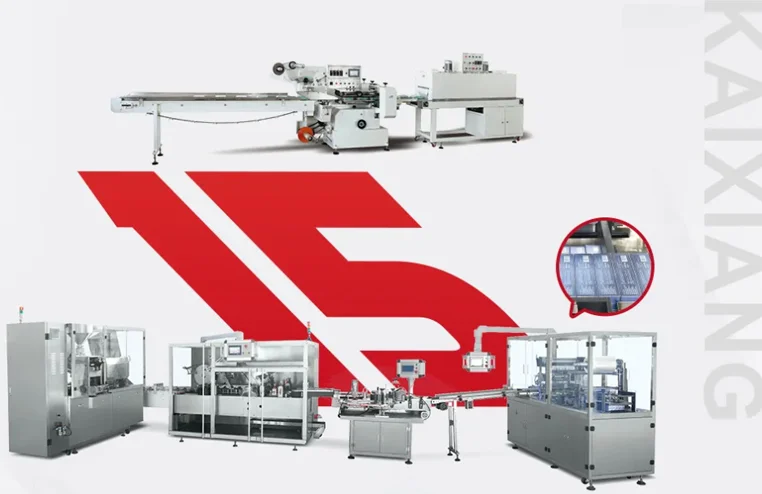
The first step in integration planning is understanding the speed characteristics of each machine. KAIXIANG‘s product range illustrates the typical speed relationship between cartoning and master carton packing equipment.
KAIXIANG’s cartoning machines cover a wide speed spectrum:
| Cartoner Model | Speed Range | Typical Application |
|---|---|---|
| KXZ-130B Series | 30-100 boxes/min | Stick packs, bulk food, trays |
| KXZ-200B | 30-50 boxes/min | Pouch foods |
| KXZ-280C Series | 100-200 boxes/min | High-speed cartoning for diverse products |
KAIXIANG‘s master carton packing machines operate at significantly different speeds:
| Master Carton Packer Model | Speed | Sealing Method |
|---|---|---|
| KXZ-400 | 16-20 boxes/min | Glue seal |
| KXZ-600 | Varies by component | Tape seal (top and bottom) |
The critical observation: A high-speed cartoner like the KXZ-280C can produce 100-200 cartons per minute, while a master carton packer like the KXZ-400 handles only 16-20 cases per minute. This disparity—often a factor of 5× to 10×—means that one master carton packer typically serves multiple cartoners or requires significant accumulation between machines.
This speed mismatch is not a design flaw; it reflects the fundamental difference between primary and secondary packaging. Cartoning involves placing individual products into small cartons—a high-speed, low-complexity operation. Master carton packing involves grouping multiple cartons, erecting a shipping case, loading the group, and sealing the case—a lower-speed, higher-complexity operation.
To compare the speed ranges of different cartoning and master carton packing platforms, you can review the automated packaging equipment series designed for primary and secondary packaging.
View our Automated Cartoning Machine Product Series and Master Carton Packing Machine overview
The fundamental rule of packaging line integration is simple: downstream equipment must have sufficient capacity to handle the output of upstream equipment, or accumulation must bridge the gap.
When integrating a cartoner with a master carton packer, three scenarios are possible:
| Scenario | Description | Result |
|---|---|---|
| Cartoner speed ≤ case packer capacity | The cartoner produces fewer cartons than the case packer can handle | The case packer is underutilized; acceptable for low-volume lines |
| Cartoner speed = case packer capacity × pack count | Perfectly matched | Ideal but rarely achieved in practice due to variability |
| Cartoner speed > case packer capacity | The cartoner produces more cartons than the case packer can immediately process | Accumulation is required to prevent backpressure and line stops |
For most production lines, the third scenario applies. A cartoner running at 100 boxes/min feeding a case packer that handles 20 cases/min (with, say, 10 cartons per case) produces 100 cartons/min while the case packer consumes 200 cartons/min at full capacity. Wait—that would mean the case packer is actually faster. Let‘s calculate properly.
Example calculation:
Cartoner speed: 100 cartons per minute
Case packer speed: 20 cases per minute
Cartons per case: 10
Case packer consumption rate = 20 cases/min × 10 cartons/case = 200 cartons/min
In this example, the case packer actually consumes cartons faster than the cartoner produces them—the line is “cartoner-constrained.” The case packer would be starved for cartons, waiting for the cartoner to catch up.
The more common scenario:
Cartoner speed: 150 cartons per minute
Case packer speed: 16 cases per minute
Cartons per case: 10
Case packer consumption rate = 16 cases/min × 10 cartons/case = 160 cartons/min
Here, the case packer is slightly slower than the cartoner (160 vs. 150). The line is balanced, but only just. Any variation—a momentary cartoner speed increase, a case packer micro-stop—will create a backlog.
Industry guidance: According to a packaging line integration analysis, the core principle is that your cartoner speed should be ≥ 1.2× your upstream maximum speed to maintain a buffer margin and absorb any feed irregularities. For cartoner-to-case-packer integration, the equivalent principle applies: downstream capacity (case packer consumption rate) should be at least 1.1-1.2× upstream output (cartoner production) to provide a buffer against variability.
Accumulation—the temporary storage of cartons between the cartoner and the case packer—is the primary tool for managing speed mismatches and production variability.
Without accumulation, any interruption in either machine stops the entire line. A 2-minute jam on the case packer would force the cartoner to stop, losing 200-400 cartons of production. With accumulation, the cartoner continues running while the case packer is cleared, and the accumulated cartons feed the case packer as it resumes.
According to a secondary packaging integration guide, when applying buffering principles, equipment upstream and downstream must have excess capacity, which can range from 20-100%. The accumulation area allows the faster machine to continue operating while the slower machine catches up.
| Accumulation Type | Description | Best For |
|---|---|---|
| In-line accumulation conveyor | Cartons accumulate directly on the conveyor between machines | Short-term buffering (1-5 minutes) |
| Accumulation table (ebb and flow) | Cartons are diverted to a separate table and returned to the main flow as needed | Medium-term buffering (5-15 minutes) |
| Slug accumulation | Cartons are grouped into “slugs” or batches that are transferred together | High-speed lines with consistent carton sizes |
| Multi-lane accumulation | Cartons are distributed across multiple lanes that feed the case packer sequentially | Applications requiring extended buffering or multiple SKUs |
To size an accumulation system, calculate the maximum expected downtime of the slower machine and multiply it by the faster machine‘s production rate.
Example:
Cartoner speed: 150 cartons/min
Case packer maximum downtime (clearing a jam): 3 minutes
Required accumulation capacity: 150 × 3 = 450 cartons
This means the accumulation system must hold at least 450 cartons to keep the cartoner running during a 3-minute case packer stoppage.
External source: A typical integrated packaging line includes product filling machines, sealing or wrapping machines, and cartoning or case packing machines. The integration of these components requires careful attention to speed matching and accumulation to achieve optimal line efficiency. As one industry analysis notes, line-wide coordination prevents bottlenecks and maximizes overall equipment effectiveness.
Beyond speed matching and accumulation, several practical considerations affect the success of your integration.
Cartons exiting a cartoner may need to be reoriented before entering the case packer. Some case packers require cartons to be stacked vertically; others require horizontal layering. The transfer system between machines must handle this reorientation without jams or damage.
Ask your supplier: “How does the transfer system handle carton orientation changes? What is the maximum carton size and weight that can be safely transferred?”
Different SKUs may require different case patterns (e.g., 3 × 4 vs. 2 × 6). The integration between cartoner and case packer must accommodate these pattern changes—either through manual adjustment or automated recipe changes.
Ask your supplier: “How does the system handle changes in case patterns? Is the changeover automated or manual?”
Both cartoners and case packers generate rejects. A properly integrated line must handle rejects from both machines without disrupting the flow of good product. This typically requires:
A reject gate or diverter after the cartoner
A reject station on the case packer
Clear separation of good and rejected cartons/cases
For seamless operation, the cartoner and case packer should share a common control architecture. This enables:
Coordinated start/stop sequences
Speed synchronization (or speed following)
Centralized fault reporting and diagnostics
Consistent recipe management across both machines
Rockwell Automation‘s integration of a cartoner and case packer, for example, uses a single controller (Allen‑Bradley CompactLogix™) to manage all 27 axes—14 for the cartoner and 13 for the case packer.
Master carton packing machines require significant floor space. The KXZ-400 measures 7700 × 1350 × 1900mm and weighs approximately 2000 kg. The KXZ-600 is a three-component system comprising a carton forming machine, an automatic carton filling machine, and a carton sealing machine. Ensure your line layout provides adequate space for the case packer, accumulation system, and access for maintenance.
For industry-specific integration considerations, you can explore daily use packing machine solutions tailored to different sectors.
View Packaging Solutions for Food & Beverage, Pharmaceutical Product Applications, and Daily Use Product Applications
Profile:
Two cartoners (KXZ-280C, 150 cartons/min each)
One master carton packer (KXZ-600)
10 cartons per case
24/5 operation
Integration challenge: Total cartoner output = 300 cartons/min. Case packer consumption = speed × 10 cartons/case. If the KXZ-600 runs at 25 cases/min, consumption = 250 cartons/min. The cartoners produce 50 cartons/min more than the case packer can consume—a 20% surplus that must be accumulated.
Solution: A multi-lane accumulation system with slug accumulation that can hold at least 15 minutes of surplus production (750 cartons). The system uses independently powered conveyors to reorient cartons from two cartoners and merge them into a single case packer.
Profile:
One cartoner (KXZ-130B, 60 cartons/min)
One master carton packer with glue seal (KXZ-400, 16-20 cases/min)
5 cartons per case
Strict tamper-evidence requirements
Integration challenge: Case packer consumption = 18 cases/min × 5 cartons/case = 90 cartons/min. Cartoner output = 60 cartons/min. The line is cartoner-constrained—the case packer would be starved.
Solution: This line does not require accumulation between machines; the case packer has excess capacity. The integration focus is on control coordination to ensure the case packer runs only when cartons are available, preventing unnecessary wear and energy consumption.
If this integration guide was useful, the following articles will help you complete your end-of-line packaging planning:
Master Carton Packing Machine Selection Guide: KXZ-400 vs KXZ-600
Case Packing Cartoning: Options for Food and Supplement Lines
End-of-Line Automation ROI Calculator
Palletizing After Case Packing: Manual, Semi-Automatic, and Robotic Options
Packaging Line Controls Integration: Synchronizing Cartoners, Case Packers, and Palletizers
Sep 14,2026
Aug 31,2026 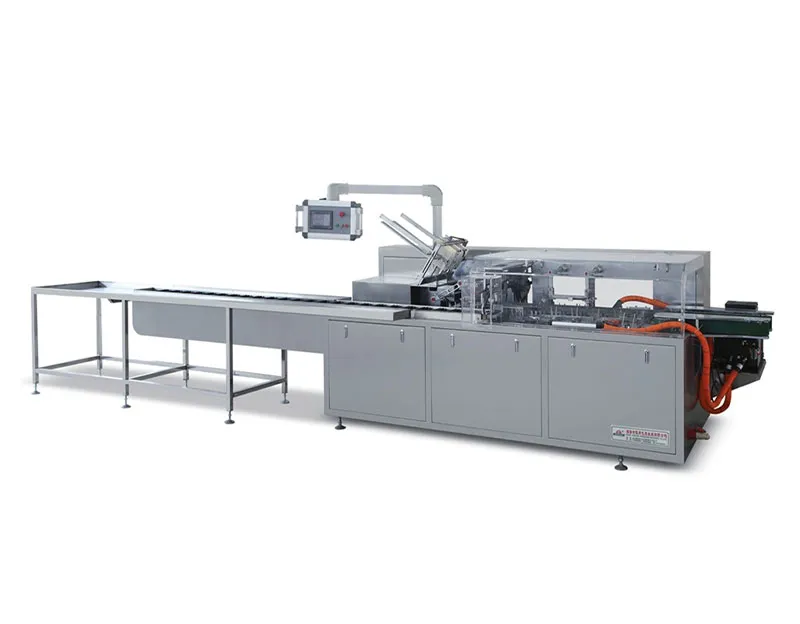
GET A QUOTE