

 Jun 02
When your production line requires 200 cartons per minute, the machine's motion type becomes a critical decision—yet many buyers discover only after installation that their chosen technology cannot handle delicate products at rated speed, or that maintenance costs eat into the efficiency gains. The fundamental difference between continuous-motion and intermittent-motion cartoners is not simply about speed; it affects product handling precision, component longevity, changeover flexibility, and total cost of ownership.
This guide explains how each motion type works, compares their real-world performance across typical applications, and provides a decision framework based on your product characteristics and production schedule. You will learn why a continuous-motion machine may struggle with heavy products, why an intermittent machine might frustrate high-volume lines, and how to match motion technology to your specific packaging reality.
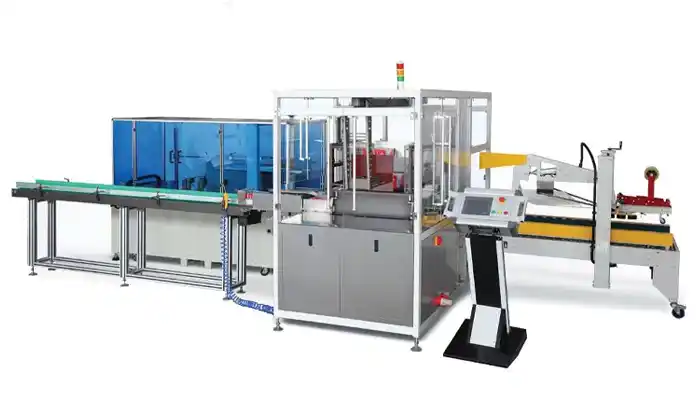
Understanding the core mechanical distinction is essential before comparing performance metrics.
In an intermittent-motion cartoner, the carton chain advances, stops, advances, stops. During each stop:
The carton is erected
Product is pushed into the stationary carton
The carton flap is tucked or glued
The chain advances to the next station
The machine operates in discrete cycles: "move, stop, operate, move again." This start-stop action means the carton is completely stationary during product insertion, allowing precise placement.
Typical speed range: 30-120 cartons per minute, with most operating reliably between 60-100 CPM.
In a continuous-motion cartoner, the carton chain moves constantly. All operations—carton erection, product insertion, flap closing—occur while the carton travels along the machine. Product insertion requires a synchronized "flying" pusher that matches the carton's speed during the push, then retracts and returns for the next cycle.
The machine never stops during normal production. Operations are timed by servo-controlled cams and linkages that move with the carton chain.
Typical speed range: 80-300+ cartons per minute, with sustained high-speed operation between 120-250 CPM.
External source: According to a 2022 technical reference from the Packaging Machinery Manufacturers Institute (PMMI), continuous-motion cartoners account for approximately 65% of new installations in applications requiring over 150 CPM, while intermittent-motion machines dominate the sub-100 CPM segment due to their simplicity and lower initial cost.
The following comparison table summarizes the trade-offs across five dimensions that directly impact your daily operation.
| Dimension | Intermittent-Motion | Continuous-Motion | Winner |
|---|---|---|---|
| Maximum sustained speed | 60-100 CPM typical; 120 CPM achievable with optimization | 120-200 CPM typical; 250+ CPM for specialized designs | Continuous (2-3x faster) |
| Product handling precision | Excellent—product inserted into a stationary carton; ideal for delicate, unstable, or heavy items | Good—requires precise synchronization; risk of product tipping during "flying" insertion | Intermittent (lower risk) |
| Component wear and maintenance | Moderate—start-stop cycles, stress drives, and clutches; brake and clutch wear are primary concerns | Moderate to high—continuous rotation reduces start-stop shock but creates constant bearing and cam wear | Tie (different wear patterns) |
| Changeover time | 15-40 minutes typical; simple mechanical adjustments | 20-60 minutes typical; more synchronized adjustments required | Intermittent (simpler, faster) |
| Initial capital cost | Lower—simpler mechanical design, fewer servos | Higher—more complex cam and servo systems | Intermittent (30-50% lower) |
Maintenance requirements differ fundamentally between the two technologies. Neither is "better"—they simply wear differently.
The start-stop nature creates stress on:
Brakes and clutches (if not fully servo-driven): Typically require replacement every 8,000-12,000 operating hours
Drive belts and chains: Subject to repeated tensioning cycles; inspect quarterly
Indexing drives: Precision components that may need recalibration annually
Advantage: When a component fails, diagnosis is straightforward because the machine's cycle is discrete. Most repairs can be completed by an in-house maintenance team.
Typical annual maintenance cost (relative): Baseline (1.0x)
The constant rotation creates different wear patterns:
Cams and followers: Subject to continuous friction; high-quality hardened cams last 15,000-25,000 hours, but replacement is labor-intensive
High-speed bearings: Require regular lubrication and temperature monitoring
Synchronized servo systems: Require specialized diagnostic tools and trained technicians
Advantage: No start-stop shock means drive motors and gearboxes often outlast intermittent-machine equivalents by 30-50%.
Typical annual maintenance cost (relative): 1.2-1.5x (higher due to specialized parts and labor)
Key insight from field data: A 2023 maintenance survey conducted among 45 packaging lines (published in Pharmaceutical Engineering magazine) found that continuous-motion cartoners averaged 14% higher annual maintenance expenditure but delivered 22% higher output. The cost per thousand cartons was actually 8% lower for continuous-motion lines running above 150 CPM.
| If your priority is... | Recommended motion type |
|---|---|
| Lowest annual repair cost | Intermittent |
| Lowest cost per thousand cartons at high volume | Continuous |
| In-house maintenance without specialists | Intermittent |
| Maximizing uptime (planned maintenance acceptable) | Continuous |
| Minimizing spare parts inventory | Intermittent |
The real selection criterion is not speed alone—it is how your product behaves during insertion.
Product characteristics that favor intermittent:
Heavy or unstable products (glass bottles over 300g, tall tubes): Stationary insertion prevents tipping
Fragile items (ampoules, diagnostic cassettes): No relative motion between product and carton during insertion
Oversize or unusual shapes (syringes, medical devices): More space for custom tooling during the stop
Frequent changeovers (multiple SKUs per shift): Simpler mechanical adjustments
Lower volumes (under 80,000 cartons per shift): Capital cost savings outweigh speed benefits
Typical industries: Pharmaceuticals (small-to-medium batch), cosmetics (premium tubes), medical devices, contract packaging with high mix.
Product characteristics that favor continuous:
Stable, self-supporting products (blister packs, sachets, flowpacks): Easily pushed during motion
High volumes (over 120,000 cartons per shift): Speed advantage dominates
Dedicated lines (one product format for weeks): Changeover time is irrelevant
Flat or low-profile products (tissue packs, wipes, flat masks): Low center of gravity during insertion
Integration with high-speed upstream equipment (VFFS at 200 packs/min): Speed matching required
Typical industries: Food (cereal, pasta, confectionery), tissue and hygiene products, high-volume pharmaceuticals (oral solid dose), beverage multi-packs.
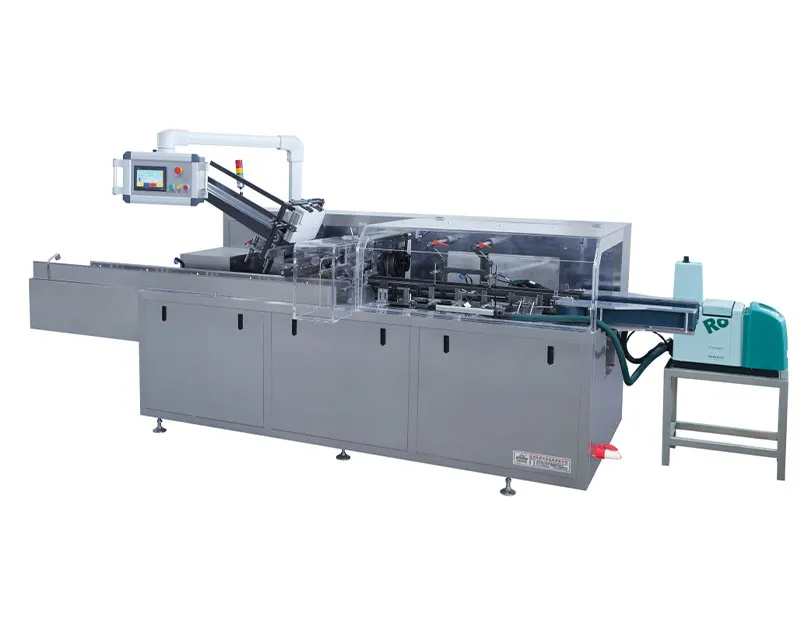
To see how KAIXIANG implements both motion types across different speed ranges, you can review the automated cartoning platforms designed for specific throughput and product handling requirements.
View our Automated Cartoning Machine Product Series→
Profile:
Blister packs containing tablets (fragile, light)
15-20 product changeovers per week
Batch sizes: 10,000-80,000 cartons
Clean room environment (ISO 7)
Selection outcome: Intermittent-motion
Rationale:
Delicate blister packs require stationary insertion
Frequent changeovers demand quick adjustments
Speed requirement (80 CPM) is within intermittent capability
Lower capital cost for multiple lines
What would be sacrificed by choosing continuous: Product damage risk increases significantly; changeover time would double.
Profile:
Flowpacked cereal bars (stable, rectangular)
Two format changes per week, maximum
Batch sizes: 500,000+ cartons
24/5 operation
Selection outcome: Continuous-motion
Rationale:
Speed requirement exceeds intermittent capability
Stable product tolerates flying insertion
Infrequent changeovers make longer setup acceptable
Lower cost per carton at high volume
What would be sacrificed by choosing intermittent: Would require 2-3 intermittent machines to achieve the same output, increasing floor space, maintenance, and labor costs.
For facilities running both delicate pharmaceutical products and high-volume food items, the choice between motion types may vary by line. You can explore application-specific considerations across different industries. View Products by Application Industry Carton Packing Machine.
The traditional binary choice is becoming less absolute. Several manufacturers now offer:
Servo-driven intermittent machines with "continuous-like" features
Faster accelerations reduce dead time between cycles
Achievable speeds up to 150 CPM for stable products
Maintains a stationary insertion benefit
Continuous-motion machines with product stabilization
Vacuum or mechanical holders secure products during insertion
Allows continuous speed with delicate items
Higher cost, but expands the application range
When evaluating these hybrid designs, request a factory acceptance test (FAT) with your actual products. A machine that theoretically handles delicate items may still show higher reject rates than a simpler intermittent design.
You now have a framework based on product stability, required speed, changeover frequency, and maintenance preferences. The next step is mapping these requirements to specific machine configurations.
Before contacting suppliers, document:
Your primary product's dimensions and weight (plus any unstable or fragile characteristics)
Maximum sustained speed requirement (calculated from daily target and shift hours)
Changeover frequency (average number per day and target changeover time)
Maintenance team capability (in-house generalists vs. specialists available)
Floor space available (continuous-motion machines are typically longer)
With this preparation, you can request motion-type recommendations and test results from suppliers rather than accepting generic speed claims.
If this motion-type comparison was useful, the following articles will help you complete your cartoner evaluation:
How to Calculate Your True Throughput Requirement for Cartoning Lines
Product Handling in High-Speed Cartoners: Fingers, Pushers, and Vacuum Systems Compared
Changeover Optimization for Intermittent-Motion Cartoners
Cam and Follower Maintenance for Continuous-Motion Machines
Infeed System Design for Continuous-Motion Cartoners
Sep 14,2026 
GET A QUOTE