

 May 14
You have 10,000 small retail boxes ready to go. They are stacked on pallets, waiting for the freight truck. And you are paying four people to manually pack them into larger shipping cartons, tape each one, and stack them back onto pallets. That labor cost is not sustainable at scale.
Here is the reality that hits most growing brands around the 50,000-unit-per-month mark: secondary packaging becomes the bottleneck. The primary packaging looks beautiful. The product inside is perfect. But getting those individual units into shipping-ready master cartons quietly eats your margin.
Let me walk you through a calculation that changed how one supplement brand approached its packaging line. They were spending 45 seconds per master carton on manual packing: open the carton, arrange 24 small bottles inside, close the flaps, apply tape, and move to the pallet.
At 80 cartons per hour per worker, with three workers on the line, their labor cost alone was $72 per hour. Over a 2,000-hour production year,thatexceeded72perhour.Over 2,000-hour production per year, which exceeded 144,000. And that number excluded the cost of tape, repetitive strain injuries, and the inevitable packing errors.
According to industry benchmarks from PMMI, automated master carton packing reduces direct labor costs by 70-85% compared to manual operations. The payback period for automated equipment typically falls between 12 and 24 months for medium-volume lines.
The basic workflow is simpler than most buyers expect. Small products—bottles, tubes, pouches, or retail boxes—enter on a conveyor. They are counted and grouped into the correct formation. A robotic arm or mechanical pusher transfers the group into an erected master carton. The carton is sealed and discharged.
The complexity lies in the variables. Case packing equipment must handle different product sizes, different carton dimensions, and different packing patterns. A line running identical products for years can use simpler machinery. A co-packer running 50 SKUs weekly needs flexible automation with tool-free changeovers.
The two dominant configurations are:
Continuous motion case packers: Products flow without stopping. Higher speed (20-40 cartons per minute) but more complex mechanics.
Intermittent (pick-and-place) case packers: Products stop while loading occurs. Lower speed (10-20 cartons per minute) but simpler and often more gentle with fragile items.
Here is a mistake I have seen repeatedly. Companies buy a case packer based solely on the product they run today. Six months later, they launch a new SKU with a different carton size. The machine cannot handle the new format without expensive retrofitting.
A beverage manufacturer in Florida learned this lesson. Their case packer was optimized for 12-can packs. When they introduced 24-can variety packs, the machine jammed constantly because the infeed grouping could not reconfigure. They spent $35,000 on modifications and lost three weeks of production.
The solution is a modular design. A machine built with servo-driven rails and adjustable product grouping can switch between formats in minutes, not hours. For operations running multiple SKUs, this flexibility is not a luxury. It is the difference between a machine that pays for itself and one that becomes a constraint.
To understand how modular configurations handle varying carton sizes, review the adjustability range of different case packing platforms.
Once products are inside the master carton, the seal must hold through the entire shipping journey. This means choosing between tape and glue, and between hot melt and cold adhesive.
Tape is simple, visible, and easy to inspect. But tape costs are higher per carton, and tape applicators require frequent roll changes.
Glue (either hot melt or water-based) is less expensive per carton and creates a tamper-evident seal. However, glue systems require cleaning and temperature management.
For high-volume lines running identical cartons, hot melt glue is typically the most cost-effective. For lines with frequent changeovers or cartons that will be stored in cold environments, tape or cold glue may perform better.
The right sealing method depends on your shipping environment, carton material, and acceptable maintenance level.
The case packer itself is only half the system. The infeed—how products arrive at the packing station—determines overall line efficiency.
Common infeed configurations include:
Single-lane infeed: Simplest, but requires products to arrive in a perfect single file. Any gap or jam stops the line.
Multi-lane accumulation: Products are spread across multiple lanes, then merge into the correct pattern. Higher throughput but more complex controls.
Robotic picking: A vision-guided robot picks products from an infeed conveyor and places them into cartons. Maximum flexibility for mixed products, but the highest cost.
A large nutritional brand reported that switching from single-lane to multi-lane accumulation increased their case packing throughput by 40% without changing the case packer itself. The bottleneck was not the packer—it was how products were fed to it.
Case packing does not exist in isolation. The packed master cartons must be palletized for shipping. Some production lines integrate the case packer directly with a palletizing system—either robotic or conventional.
Integration offers two advantages. First, it eliminates manual pallet stacking. Second, it allows the case packer to arrange cartons on the pallet in specific patterns that maximize shipping stability.
A major e-commerce fulfillment center in Ohio reported that integrating its case packer with an automatic palletizer reduced loading dock time by 60% and eliminated pallet-related product damage entirely.
When evaluating automated master carton packing, use this simple formula:
Annual savings = (Current manual labor cost + Current material waste + Current damage cost) – (New labor cost + New maintenance cost + New consumables cost)
Be honest about the "soft" savings, too. Manual packing lines have higher injury rates from repetitive lifting. Automated lines run consistently at the end of shifts. They do not get tired or distracted.
One contract packager shared their data: manual packing had a 2.3% error rate (wrong products, wrong counts, poor seals). Automation reduced that to 0.2%. At 500,000 master cartons annually, that is 10,500 fewer errors.
For a detailed look at how different automation levels affect these cost factors, explore the configuration options for various production volumes.
Not every operation needs a fully automatic case packer. Here is a decision framework:
Manual packing makes sense when:
You pack fewer than 50 master cartons per day
Your product mix changes completely every week
You have very low labor costs (below $12/hour)
Semi-automatic (operator-assisted) packing makes sense when:
You pack 50-200 master cartons daily
You have 2-5 different carton sizes
Labor costs are moderate ($12-20/hour)
Fully automatic packing makes sense when:
You pack over 200 master cartons daily
You have standard carton sizes or servo-adjustable changeovers
Labor costs exceed $20/hour, or labor availability is unreliable
The threshold for automation has dropped significantly in recent years. Lower-cost servo drives and simplified controls have made case packaging machinery accessible to smaller operations that would not have considered it a decade ago.
Here is something equipment brochures do not emphasize: consistent packing quality affects your brand reputation. A master carton that arrives with a poor seal, crushed corners, or loose packing suggests carelessness. Distributors notice. Retailers notice.
Automated packing applies the same pressure, the same glue pattern, the same carton squareness every cycle. Manual packing introduces variability. One worker seals tightly. Another leaves flaps loose. That inconsistency creates risk.
For brands supplying major retailers like Walmart, Target, or Costco, consistent master carton quality is not optional. Retailer compliance guidelines specify everything from carton compression strength to seal integrity. Automated packing helps meet those specifications reliably.
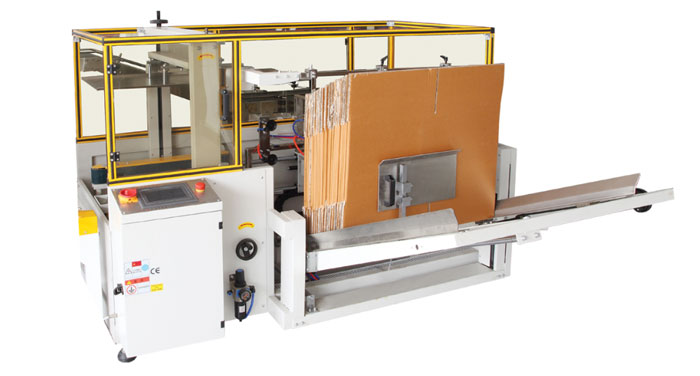
The transition to automated master carton packing does not require starting with a fully integrated line. Many companies begin with a semi-automatic carton erector and sealer, then add an automatic product infeed as volumes grow.
The key is choosing a modular platform that can scale with you. A machine that is semi-automatic today should accept automatic infeed modules tomorrow. The control system should support additional sensors and verification stations.
If your current packing process feels like a bottleneck—or if you are struggling to find reliable packing labor—see how scalable platforms address different volume requirements before assuming automation is out of reach.
Sep 14,2026
Aug 31,2026
Aug 26,2026 
GET A QUOTE